ETH DECOL
Initiative to create transparency about the historical entanglements of ETH Zurich and its faculty with colonialism and racism (1860-1980)
CONTEXT AND GOALS
In 2030, ETH-Zürich will celebrate its 175th anniversary. This provides a welcome invitation to retrace this proud institution’s historical trajectories and engage with various facets of its past. On the occasion of ETH’s 150th anniversary, David Gugerli and his team at the Chair for the History of Technology produced Transforming the Future (orig. Die Zukunftsmaschine, 2005), a fine in-house history of Switzerland’s premier research university that deftly situates its rise and growth not only within shifting scientific paradigms, but also within the fluctuating social and political contexts in Switzerland and Europe during the nineteenth and twentieth centuries. However, some thorny questions have entered the realm of academic and public debates just relatively recently that were rarely asked in 2005. It is hence only with the benefit of hindsight that we can spot a glaring lacuna in what is otherwise an impeccable piece of historical craftsmanship: Die Zukunftsmaschine remains largely silent about the significance of non-Western contexts and historical actors for the development of ETH. The frame of reference is mostly a Swiss national (and occasionally a European) one. The conspicuous absence of the Global South in the existing historical account of ETH leads to the neglect of two issues that many would consider seminal for the global self-positioning of high-profile institutions of higher education in the 21st century.
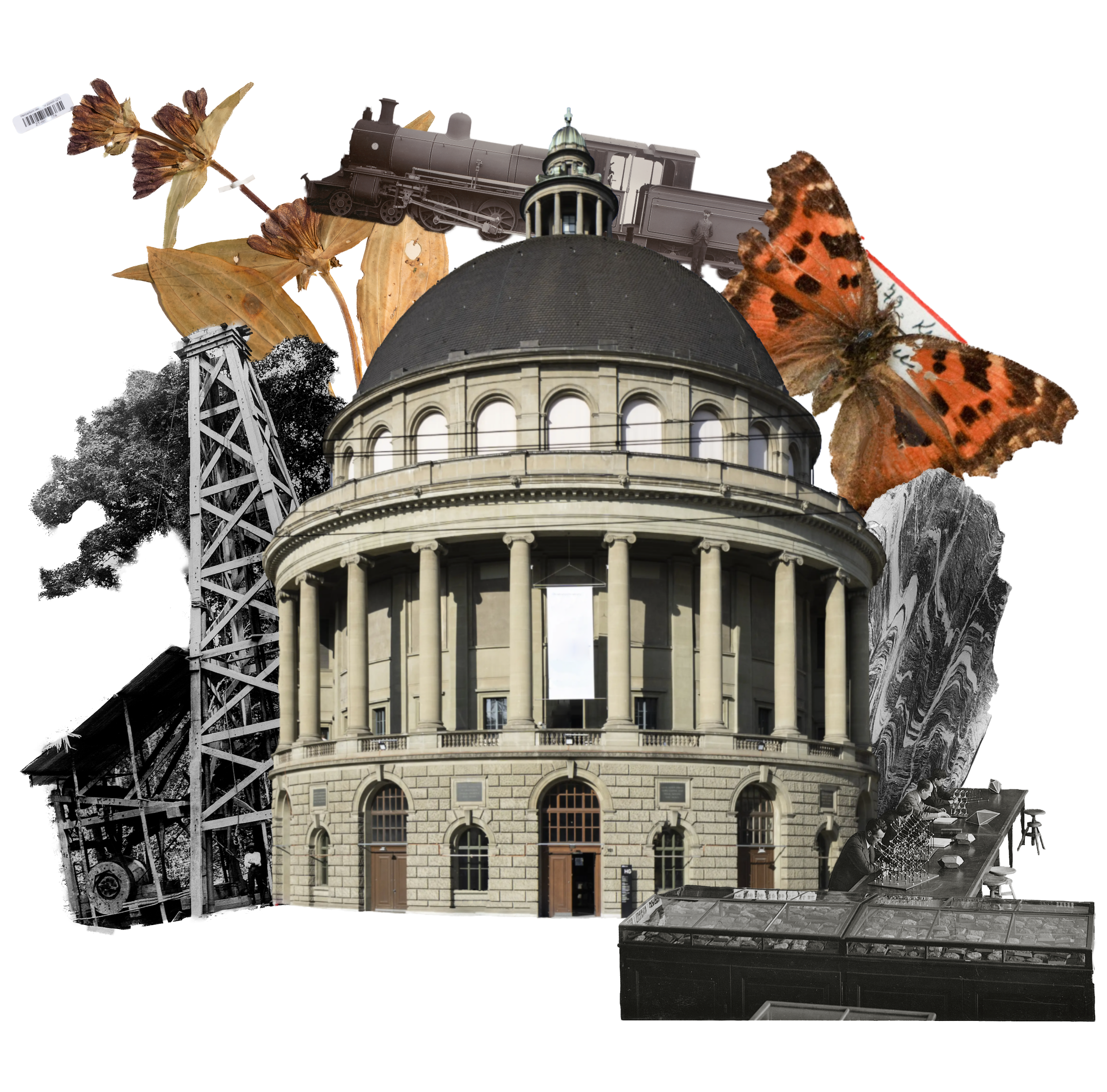
For one, the question of the enmeshment of ETH as an institution and ETH faculty members individually within European colonialism and/or racist agendas remains invisible. The historical investigation of ETH’s colonial history, and that of the natural and technical sciences in Switzerland more broadly, seems even more pressing considering the increased public attention attracted by Swiss entanglements in slavery, colonial warfare, or racist imagery in the Swiss public sphere in recent years. Moreover, quite a few disciplines contributing to ETH’s reputation as a leading institution of modern, scientific progress − such as agricultural science, entomology, or comparative biology – are intricately linked to the history of European expansion. Relatedly, the production of scientific and technological knowledge was frequently designed to support colonial designs and ends. „Open air sciences“ such as geology, geography, botany, or zoology were particularly crucial for the success of colonial conquest and exploitation. As a result, vast collections of minerals, plant specimens, embalmed animals or fossils were brought back to European universities – including ETH – from colonial expeditions (and not seldom helped launch academic careers in Europe and North America) and have subsequently been used by generations of lecturers and students. In most cases, however, these objects’ colonial past has barely been studied so far despite recent controversies discussions surrounding the provenance, restitution, and repatriation of ethnological or art collections from colonial contexts.
Second, invisibility and „colonial amnesia“ also appears to be a substantial problem when it comes to the hundreds of students, doctoral candidates and researchers from Asia, Africa, Latin America and Pacific who have passed through ETH Zurich during the first 120 years of its existence. Alongside the increased public and academic attention directed towards colonial history, the issue of combating all forms of racial discrimination and promoting cultural and ethnic diversity has also become crucial for leading universities all over the world. Renowned institutions such as Cambridge, Harvard, Rutgers or Columbia have started addressing these twin issues already years ago.
Inspired by these pioneering efforts, the ETH-Decol initiative hence pursues three main objectives:
First, it aims to shed light on the multifaceted collaborations between ETH researchers and colonial administrations and agendas, to reconstruct the ways in which knowledge (in the form of scientific collections, archives, publications, textbooks, lectures etc.) produced at ETH was shaped by colonial/colonized contexts and actors, and how scientific knowledge contributed to the colonial project more broadly. While most certainly shedding new light on an hitherto untouched research lacuna in historiography, the initiative simultaneously creates public awareness about this previously unknown chapter in ETH’s history and that of Switzerland more generally. Following recent trends in „public“ and „digital history“, the initiative’s findings will communicated to broad audiences inside and outside of ETH through a variety of channels ranging from public lectures, workshops, and guided tours to blogs and podcasts. These channels will not only be designed to reach a wider, non-academic public in Switzerland, but also to disseminate the project’s insights globally.
Second, the initiative seeks to make the history of early non-western students and faculty at ETH visible. This appears to be a particularly timely exercise in our days, when students from 120 countries are enrolled in the various study programs of ETH and when achieving diversity in faculty and student body has become a declared goal of top-ranking research institutions worldwide. Creating an awareness about the long history, the achievements and struggles and tribulations of ETH members from the Global South has two main functions. Next to making it easier for current students or researchers from Africa, Asia and Latin America to fully connect to and identify with their host institution, it also conveys the important message to internal and external audiences that ethnic and cultural diversity, far from being a recent fad, has a long tradition at ETH and, in turn, that ETH had historically greatly benefitted from diverse students and faculty.
Third, the project sets out to rethink and recalibrate the official culture of memory at ETH by problematizing and recontextualizing statues, busts, paintings and memorial plaques devoted to scholars who have been involved in acts of “colonial complicity” or become conspicuous through the spread of racist theories or other discriminatory discourses and practices. The recent report by Monika Gisler has persuasively shown that there are dozens of highly questionable memorial objects scattered over several ETH buildings celebrating, amongst others, advocates of ‘scientific racism’ such as Georges Cuvier and Louis Agassiz or imperialists like Carl Wilhelm von Gümbel, who prepared the ground for German colonial expansion in the 1880s. Given the current interest of a general public in the problematic legacies of colonialism in museums and public places, it is high time to address this issue.