Subprojects
Curating Colonial Nature: Legacies of Empire in Swiss Natural History Collections, 1870s-1950s (Monique Ligtenberg)
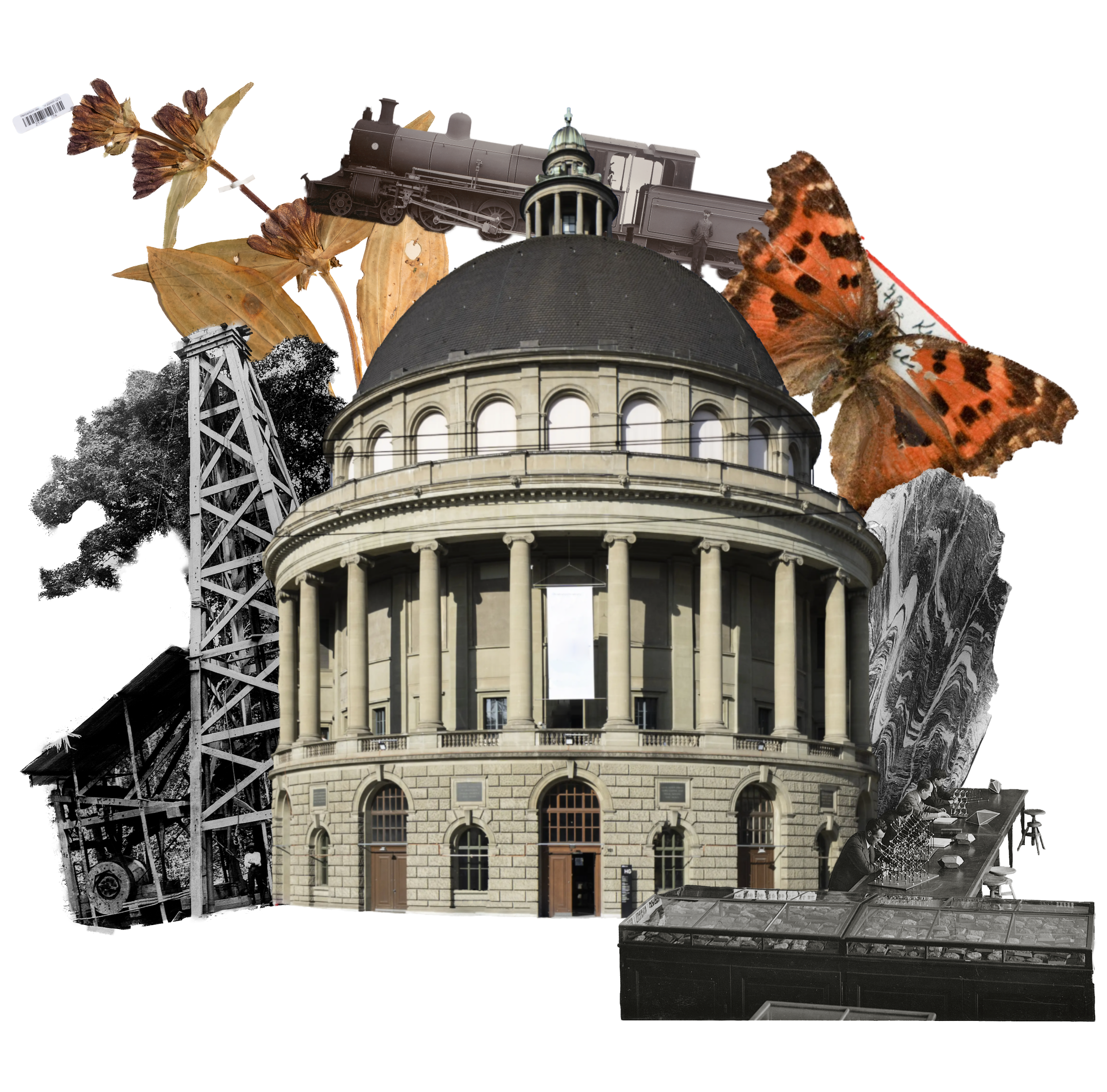
This project investigates the colonial history of natural history collections and their collectors at the Swiss Federal Institute of Technology (ETHZ), the largest and internationally most renowned educational institution for science and technology in Switzerland. While the role of plant, animal and rock specimens in colonial exploration and exploration have fallen under increased historiographical scrutiny in ‘traditional’ imperial metropoles such as Britain, Portugal, or the Netherlands, natural history ‘made in Switzerland’ – never a formal colonial power itself – has barely been systematically studied in its global, historical context so far. As an overarching aim, the project hence unearths the hitherto unexplored connection between the establishment of geological, botanical, zoological, entomological or pharmaceutical university collections in Switzerland and the imperial conquest of Asia, Africa and the Americas from the age of ‘high imperialism’ to the early days of decolonization.
First, the study reconstructs the various institutional, interpersonal, and logistical networks that facilitated the exchange of natural history specimens between the colonies and Switzerland. Adopting a multifaceted approach, it investigates the exchange of specimens between ETH Zurich and colonial research institutions during the Age of Empire, delves into individual researchers’ colonial collecting expeditions, and assesses how the burgeoning global market for plant and animal specimens fueled the rapid growth of academic natural history collections, including those at ETH.
Second, the project investigates the extent to which individual Swiss botanists, zoologists, entomologists, or geologists benefitted from the infrastructures and asymmetric rule established by neighboring European countries in forging their research career and shaping their scholarly interests. On the one hand, it asks how colonial research expeditions and the acquisition of from a European perspective previously unknown natural history specimens could serve as a valuable means in claiming scientific authority. On the other hand, it highlights the ways in which Swiss scientists not only benefitted from the labor and expertise of local populations in the colonies, but also how indigenous Asian, African, and American experts and epistemologies shaped Swiss perceptions of nature.
Relatedly, a third focus of the project is on the ‘backflows’ of empire, specifically examining how the global entanglements of Swiss naturalists influenced the construction of knowledge on colonized natures, peoples, and environments in Switzerland itself. For this purpose, the study investigates how perceptions of nature emerging from colonial expeditions and encounters were reflected in the academic curricula at ETH, in what contexts natural history specimens from the colonies were incorporated into teaching and research, and to what extent this knowledge was disseminated among a broader, Swiss audience through popular publications or public lectures.
In alignment with the global framework and topical relevance of the project, several public history and outreach activities are planned. These include the development of novel teaching formats and the creation of new blogs and podcasts in close collaboration with the ETH Collections and Archives. In the long term, the data collected in the course of the project will be made accessible on a global scale through a specialized database, established in partnership with NAHIMA – Natural Science Collections Online, that documents and maps the provenance of ETH’s natural history collections from colonial contexts. The database aims to initiate a global discussion on the various (and potentially diverging) present-day meanings ascribed to natural history collections and to identify strategies for overcoming existing asymmetries in access to plant, animal and rock specimens.
Engineering Empires: ETH Zurich as a Training Ground for (Post-)Colonial Technical Expertise, c. 1860–1980 (Philipp Krauer)
This project examines the role of ETH Zurich (until 1911 Federal Polytechnical Institute) as a training ground and knowledge hub for experts operating in colonial and postcolonial contexts. As part of the SNSF project ‘Engineering Empires from the Margins: Global Techno-Colonialism and the Swiss Federal Institute of Technology’, the study investigates how knowledge produced and circulated at ETH Zurich intersected with imperial expansion, colonial resource extraction, (anti-)colonial politics, and postcolonial ‘development’ initiatives.
Drawing on a broad understanding of engineering, the project traces the trajectories of mechanical, civil, and chemical engineers, as well as architects and agronomists trained at ETH who pursued careers across Asia, Africa, and Latin America. It examines how students from ‘neutral’ Switzerland, colonised territories, and imperial powers acquired knowledge at ETH and how the expertise they gained in Zurich was applied in various contexts, including plantation economies, infrastructure projects, industrial enterprises, and so-called ‘technical development’ programmes. In this sense, ETH emerges not only as an educational institution but also as a central node in global networks of expertise.
Furthermore, the project analyses the links between ETH Zurich, private industry, and colonial economies. Swiss companies hired and relied on engineers trained at ETH to gain access to colonial markets where they participated in infrastructure construction, resource extraction, or in selling their products. At the same time, however, research conducted at ETH contributed to attempts to replace colonial commodities such as indigo with synthetic industrial substitutes, revealing complex relationships between global trade, industrial production, and scientific research.
A further contribution of the study highlights the backflows of knowledge. Engineers and scientists did not simply export technical expertise overseas. Instead, experiences in colonial and postcolonial contexts, including encounters with indigenous practices, agricultural knowledge, and environmental conditions, fed back into research, teaching, and laboratory work in Zurich. ETH thus functioned not only as a centre of knowledge diffusion but also as a site where colonial and indigenous knowledge was selectively appropriated, transformed, and integrated into the training of future experts.
Mapping Empire’s Fuel: Colonial Geology at ETH Zurich and the Hunt for Oil, 1870–1960 (Sarujan Theivendran)
This dissertation examines the global entanglements and disciplinary transformations within geology; a field, which from its inception operated in a global context and, by the early 20th century, became increasingly vital to colonial resource extraction. Although geology played a central role in constructing and exploiting colonies, its position within the field of history of science and empire remains barely unstudied. Applying a global-microhistorical approach, the project seeks to fill this gap through the lens of the trajectories of the professor of geology Albert Heim at Swiss Federal Institute of Technology (hereafter ETH or, until 1911, Federal Polytechnic, hereafter FP) and his globetrotting son, the petroleum geologist Arnold Heim. By analysing the intertwined biographies of father and son, this study explores how geologists operated within and across imperial spaces, how their expertise fuelled imperial economies, and how global networks shaped geological knowledge.
Although Albert Heim’s research was mainly centred in Switzerland, he was part of a rapidly globalising discipline that increasingly relied on comparative material from across the world. Through the ETH/FP’s geological collection assembled from global collectors, including those operating within European overseas colonies, Heim Sr. was able to study glaciers in tropical zones, without barely travelling overseas. Like his academically trained father, Arnold Heim pursued a career in geology but ultimately chose a path that diverged from academia. Heim Jr. capitalised on new opportunities in the burgeoning oil industry at the beginning of the 20th century and contributed to (neo-) colonial oil exploration, working for companies in the Dutch East Indies, in the Arabian Peninsula and Iran.
The analysis proceeds along two sets of questions. First, it investigates the establishment and professionalisation of geology at the ETH/FP and situates geologists within imperial modernity. Albert Heim’s collecting practices and his teaching reveal how geological knowledge relied on global networks, comparative materials, and transimperial infrastructures. Second, the dissertation explores the emergence of Swiss geologists as sought-after petroleum specialists in colonial contexts. Arnold Heim’s career exemplifies how geologists were prepared for overseas employment at a time when domestic career prospects were limited.
By exploring the global entanglements of the Heim family, many of the shifts, tensions, and contradictions with the geological profession and discipline operating under the conditions of imperial modernity can be made transparent. Therefore, the study traces why Switzerland became a centre for training petroleum geologists and what roles these actors played in imperial and (neo-)colonial settings.